Founder
LIA CHAVEZ
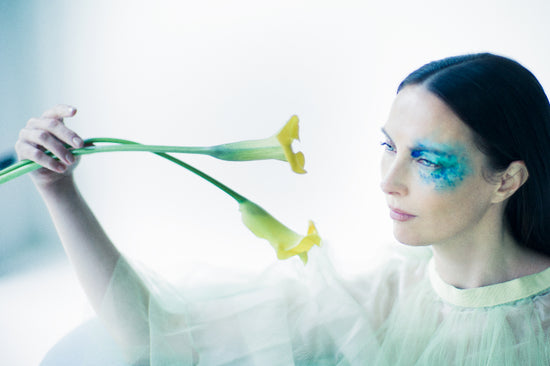
Artist, scholar, and steward of botanical traditions, Chavez has devoted her life's work to the study of light and the living world it animates.
Her fascination with light began in childhood. Drawn to luminous phenomena from an early age, she spent countless hours observing the subtle relationship between light, perception, imagination, and nature—a lifelong inquiry that would come to shape both her artistic practice and her work with medicinal plants. At Oxford, Chavez studied feminist aesthetics, entering the long lineage of women who preserved and transmitted botanical, medicinal, and intellectual knowledge across centuries: abbesses, herbalists, apothecaries, and visionaries. She later studied fine art at Goldsmiths, University of London, where light became her principal medium. Her work has been presented internationally, from the Venice Biennale and Tate Britain to the Massachusetts Institute of Technology.As her study of light deepened, it led her increasingly toward plants—the great transformers of light into life. Her botanical education encompasses the study of plant science under T. Colin Campbell, herbalism under Rosemary Gladstar, and more than three decades of cultivation, preparation, and contemplative practice in her own garden. Through these converging disciplines, she developed a profound understanding of medicinal plants and their role in supporting vitality, beauty, and restoration.
A defining influence on her work was Hildegard von Bingen, the twelfth-century Benedictine abbess, physician, composer, botanist, and visionary. In Hildegard's concept of viriditas—the greening vitality that animates all living things—Chavez recognized an inheritance that united her studies of light, botanical knowledge, and beauty. From this encounter, Hildegaard was born.
The house is founded upon the conviction that the body is a temple, and upon the practice of anointing—one of humanity’s most enduring rituals of care, through which botanical preparations have nourished, restored, and consecrated the body.
Each creation reflects a devotion to medicinal plants and meticulous craftsmanship, and the belief that beauty finds its highest expression not in adornment, but in restoration.
At the heart of the house is a simple understanding: that beauty begins in what Saint Hildegard called Lux Vivens—the Living Light—through which the botanical world reveals itself as one of humanity’s most profound sources of wisdom and renewal.